Whether you play competitive sports, participate in a recreational league, run several times per week, go to the gym, or simply enjoy staying active, an injury can be incredibly frustrating.
One day you’re training normally.
The next, you’re wondering whether that pain in your knee, ankle, shoulder, hip, or back means you need to stop completely.
Even after the initial pain begins improving, another question quickly appears:
When is it actually safe to return to activity?
Returning too quickly can leave you struggling with pain or unable to perform at your previous level. On the other hand, avoiding activity for longer than necessary can contribute to weakness, reduced conditioning, and a loss of confidence.
This is where a structured physiotherapy program can help.
At CN Physiotherapy, we work with active people from Ottawa, Navan, Orléans, Fallingbrook, Blackburn Hamlet, Beacon Hill, Cumberland, Nepean, and surrounding communities who want to recover from injuries and safely return to the activities they enjoy.
The goal isn’t simply to make the injured area hurt less.
A successful sports rehabilitation program should help you rebuild the physical abilities you need for your sport.
What Is a Sports Injury?
A sports injury is any injury or musculoskeletal problem that occurs during or interferes with physical activity. The U.S. National Library of Medicine’s sports-injury resource includes sprains, strains, knee injuries, tendon problems, fractures, and dislocations among common examples.
Sports injuries aren’t limited to competitive athletes.
You may develop an injury while:
- Running
- Cycling
- Playing hockey
- Playing soccer
- Golfing
- Skiing
- Playing pickleball
- Playing tennis
- Weightlifting
- Hiking
- Skating
- Playing basketball
- Participating in recreational leagues
- Exercising at the gym
Injuries can occur suddenly or develop gradually.
A soccer player who twists an ankle has experienced an acute injury.
A runner who gradually develops knee pain over several weeks may be dealing with an overuse-related problem.
Both situations can benefit from proper assessment.
What Are the Most Common Sports Injuries?
Sports injuries can affect almost any part of the body.
Some commonly encountered problems include:
- Ankle sprains
- Knee injuries
- Muscle strains
- Tendon-related pain
- Shoulder injuries
- Rotator cuff problems
- Tennis elbow
- Golfer’s elbow
- Shin pain
- Achilles tendon problems
- Plantar heel pain
- Hip pain
- Lower back pain
- Neck pain
- Concussions
- Overuse injuries
The treatment for each condition can be very different.
That is why a rehabilitation program should be based on an assessment rather than simply treating every sports injury with rest, ice, and stretching.
Acute Sports Injuries vs Overuse Injuries
Understanding how your injury developed can provide useful information.
Acute Sports Injuries
Acute injuries happen during a specific event.
You may remember exactly when it occurred.
Examples include:
- Rolling your ankle while playing basketball
- Twisting your knee during soccer
- Falling while skiing
- Pulling a hamstring while sprinting
- Injuring your shoulder during a hockey collision
- Landing awkwardly after jumping
Symptoms may appear immediately.
Overuse Injuries
Overuse problems usually develop gradually.
There may not be one memorable moment when the injury occurred.
Instead, you begin noticing discomfort during or after activity.
Over time, symptoms become more frequent.
This pattern can occur when training demands increase faster than the body can adapt. An International Olympic Committee consensus statement archived by the U.S. National Library of Medicine discusses the relationship between training load, recovery, injury, and athlete health.
For example, you might suddenly increase:
- Running distance
- Running speed
- Number of training days
- Weightlifting volume
- Sports practices
- Games per week
- Jumping volume
Rehabilitation should consider these training factors instead of focusing exclusively on the painful area.
Why Do Sports Injuries Happen?
There is rarely one universal explanation.
Sports injuries can involve a combination of factors.
These may include:
- Sudden trauma
- Rapid increases in training
- Fatigue
- Reduced strength
- Reduced mobility
- Previous injuries
- Insufficient recovery
- Changes in equipment
- Changes in playing surface
- Repetitive movements
- Sport-specific demands
Sometimes injuries happen even when you have done everything correctly.
Sports involve movement, speed, contact, and unpredictable situations.
Not every injury can be prevented.
The objective of physiotherapy is to identify the factors that can be addressed and prepare your body for the demands of your activity.
Should I Stop Playing Sports If I Am Injured?
It depends on the injury.
Some conditions require a temporary break from the aggravating activity.
Others may allow you to continue participating with modifications.
For example, a runner may temporarily reduce mileage rather than stop exercising entirely.
A hockey player with an upper-body injury may still be able to perform certain lower-body conditioning exercises.
An injured weightlifter may modify exercises, resistance, or range of motion.
This concept is important.
Rehabilitation does not always mean complete rest.
The goal is often to maintain as much safe activity as possible while allowing the injured area to recover.
Why Complete Rest Isn’t Always the Answer
Rest can be appropriate during certain stages of an injury.
However, prolonged inactivity can also have consequences.
You may lose:
- Strength
- Endurance
- Mobility
- Coordination
- Sport-specific fitness
- Confidence
When it is appropriate, physiotherapy helps introduce movement and loading gradually. The U.S. National Institute of Arthritis and Musculoskeletal and Skin Diseases also identifies rehabilitation as part of treatment for many sports injuries.
This prepares your body for activity rather than expecting you to suddenly return to sport after weeks of complete rest.
How Can Physiotherapy Help a Sports Injury?
Sports physiotherapy focuses on restoring the physical qualities required for your activity.
Your treatment may initially focus on pain and mobility.
As you improve, rehabilitation can become progressively more challenging.
Depending on your injury, treatment may involve:
- Therapeutic exercise
- Strength training
- Mobility exercises
- Balance training
- Coordination exercises
- Manual therapy
- Sport-specific exercises
- Plyometric exercises
- Running progression
- Return-to-sport testing
- Education and activity modification
The exact combination depends on your condition.
What Happens During a Sports Injury Physiotherapy Assessment?
Your first appointment should involve more than asking where it hurts.
Your physiotherapist may ask:
- How did the injury occur?
- When did symptoms begin?
- What sport do you play?
- How often do you train?
- Did your training recently change?
- What movements cause pain?
- Have you had this injury before?
- What position do you play?
- When do you want to return?
- What level of activity are you returning to?
Your physical assessment may evaluate:
- Range of motion
- Strength
- Balance
- Coordination
- Walking
- Running mechanics
- Squatting
- Jumping
- Landing
- Sport-specific movements
The assessment should reflect your goals.
A recreational golfer requires a different rehabilitation plan than a competitive soccer player.
Rebuilding Strength After a Sports Injury
Strength is one of the most important components of many rehabilitation programs.
After an injury, the affected muscles may become weaker.
Sometimes this happens because pain limits how much you use them.
Other times, you may have been resting or protecting the injured area.
Your physiotherapist can progressively strengthen the injured area and surrounding muscles.
The key word is progressively.
Doing too little may not prepare you for sport.
Doing too much too quickly may aggravate symptoms.
Rehabilitation aims to find the appropriate level between those extremes.
Therapeutic Exercise for Sports Injuries
At CN Physiotherapy, therapeutic exercise can be used to improve strength, flexibility, mobility, balance, coordination, and overall physical function.
Your exercise program should change throughout your recovery.
Early exercises may be relatively simple.
Later exercises may more closely resemble your sport.
For example, an athlete recovering from a knee injury might progress from basic strengthening to:
- Squatting
- Single-leg exercises
- Jumping
- Landing
- Direction changes
- Running
- Sport-specific drills
The goal is to build a bridge between rehabilitation and real activity.
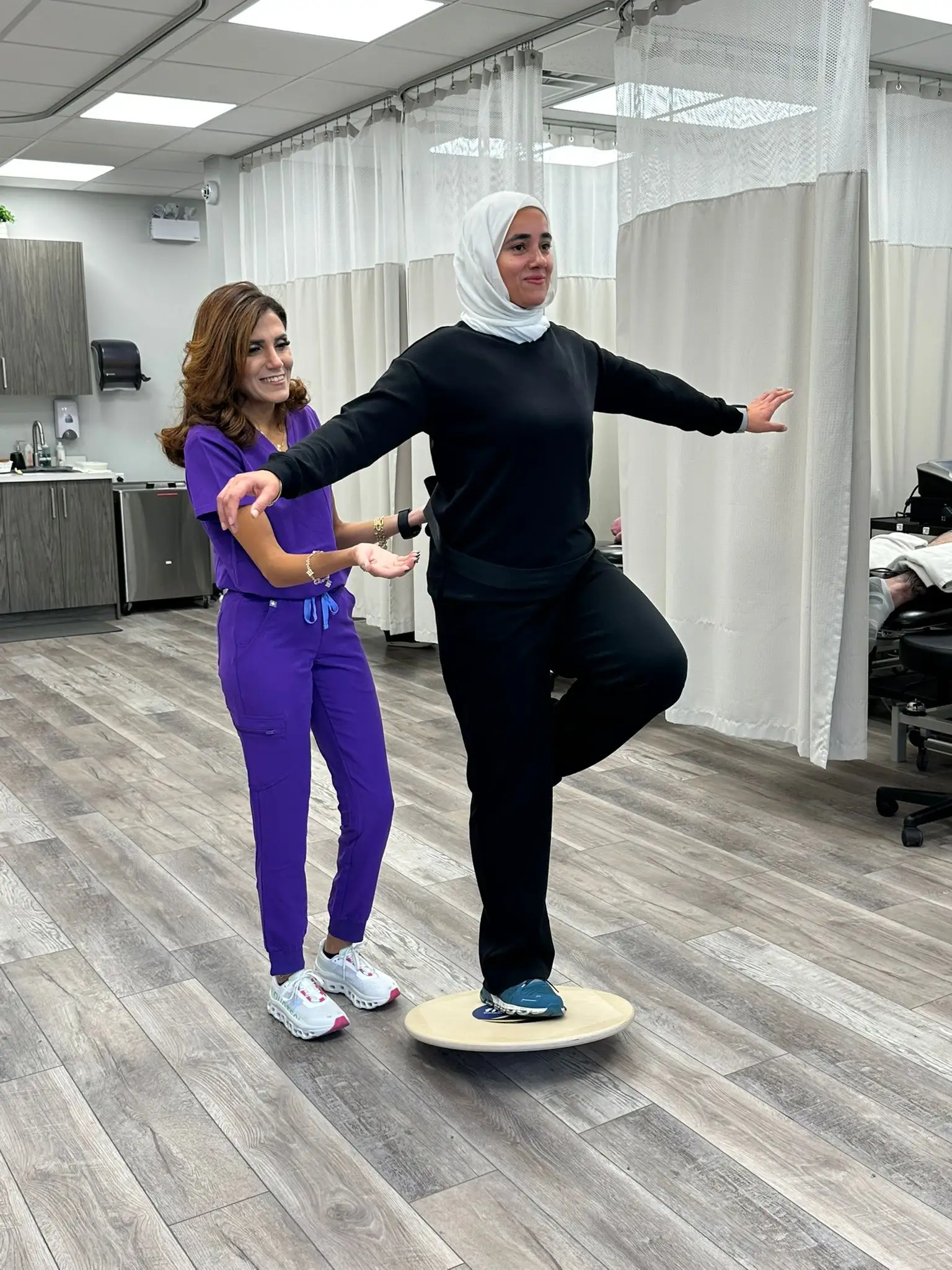
Balance and Coordination After Injury
Balance is particularly important following certain lower-limb injuries.
An ankle sprain is a good example.
After an ankle injury, returning to sport requires more than simply waiting for swelling to disappear.
You may need to rebuild:
- Ankle strength
- Balance
- Coordination
- Landing control
- Change-of-direction ability
This becomes especially important for sports such as soccer, basketball, tennis, pickleball, and hockey, where movement is unpredictable.
Why Previous Injuries Matter
Have you ever noticed that the same ankle keeps getting sprained?
Or the same hamstring keeps becoming painful?
Previous injury can be an important part of your physiotherapy assessment.
If you returned to activity before fully restoring strength, mobility, balance, or sport-specific capacity, some deficits may remain.
A rehabilitation program should therefore look beyond the immediate pain.
Manual Therapy for Sports Injuries
Manual therapy may be incorporated into sports rehabilitation when appropriate.
Physiotherapists can use hands-on techniques to address joint or soft-tissue restrictions and improve movement.
Manual therapy can be useful, but sports rehabilitation usually should not end there.
If your goal is returning to running, hockey, soccer, golf, or weightlifting, your body eventually needs to tolerate the forces involved in those activities.
That requires active rehabilitation.
Dry Needling for Sports Injuries
CN Physiotherapy also offers dry needling.
Dry needling may be considered for certain musculoskeletal conditions involving pain and muscle tension.
It is one possible treatment tool rather than a complete sports rehabilitation program.
Your physiotherapist can determine whether dry needling is appropriate based on your injury and assessment.
Kinesio Taping for Sports Injuries
Kinesio taping may also be incorporated into treatment for certain patients.
Taping can sometimes provide support or assist with movement awareness while you recover.
However, tape does not replace strengthening and progressive rehabilitation.
The long-term objective is to help your body tolerate activity independently.
Shockwave Therapy for Sports Injuries
Some persistent sports injuries involve tendons.
Examples may include problems around the Achilles tendon, patellar tendon, elbow, shoulder, or plantar fascia.
CN Physiotherapy offers shockwave therapy, which may be considered for certain chronic musculoskeletal and tendon-related conditions.
A physiotherapist should first assess the injury to determine whether shockwave therapy is appropriate.
Returning to Running After an Injury
Running places repeated loads through the body.
If you have stopped running because of an injury, immediately returning to your previous distance and speed may be too large a jump.
A gradual return-to-running program may begin with combinations of walking and running.
Over time, you can progressively increase:
- Running duration
- Distance
- Frequency
- Speed
- Hills
Your physiotherapist can help determine when these progressions are appropriate.
Returning to Hockey After an Injury
Hockey requires a unique combination of:
- Strength
- Balance
- Speed
- Rotation
- Coordination
- Endurance
- Contact tolerance
Simply being able to walk without pain does not necessarily mean you’re ready to return to hockey.
Your rehabilitation should eventually prepare you for skating, acceleration, stopping, turning, shooting, and other demands relevant to your position and level of play.
Returning to Soccer
Soccer requires much more than running in a straight line.
Players need to:
- Accelerate
- Decelerate
- Change direction
- Kick
- Jump
- Land
- React quickly
- Maintain endurance
Return-to-sport rehabilitation should eventually address these demands.
Returning to Pickleball and Tennis
Pickleball and tennis involve quick lateral movements, sudden stops, rotation, and repeated upper-body movements.
Common problem areas may include the:
- Shoulder
- Elbow
- Knee
- Calf
- Achilles tendon
- Ankle
Your rehabilitation should reflect the movements required on the court.
Returning to Golf
Golf may appear relatively low-impact, but a golf swing requires coordinated movement through the hips, spine, shoulders, and upper limbs.
Golfers may experience problems involving:
- Lower back
- Shoulder
- Elbow
- Wrist
- Hip
- Knee
A physiotherapy program can help address the physical requirements of returning to the course.
Returning to Weightlifting
Many gym-related injuries occur when training volume, resistance, or frequency increases too quickly.
If you are recovering from an injury, the goal does not have to be avoiding weights forever.
Instead, your physiotherapist can help you progressively reintroduce resistance.
This might involve changing:
- Weight
- Repetitions
- Range of motion
- Exercise selection
- Training frequency
As your capacity improves, your program can become more demanding.
Sports Injuries in Ottawa and Navan
Living in Ottawa provides plenty of opportunities to stay active throughout the year.
Residents of Navan, Orléans, Fallingbrook, Blackburn Hamlet, Beacon Hill, Cumberland, Nepean, and surrounding communities participate in everything from recreational hockey and soccer to running, cycling, skiing, golf, pickleball, and gym training.
Our seasons also create unique changes in activity.
You may spend the winter skating and skiing, then suddenly transition into running, cycling, golf, gardening, and outdoor sports in spring.
Large changes in activity can sometimes challenge tissues that are not prepared for the new workload.
Gradually transitioning between activities can help your body adapt.
Ottawa Winters and Sports Injuries
Winter creates additional challenges.
Ice and snow can contribute to falls and awkward movements.
Winter sports also place specific demands on the body.
Then there is snow shovelling, which can feel like a workout of its own.
If you sustain an injury during winter, rehabilitation can help you maintain conditioning and prepare for your return to activity.
How Do I Know When I’m Ready to Return to Sport?
This is one of the most important questions in sports rehabilitation.
There is no universal test.
Depending on your sport and injury, your physiotherapist may consider:
- Pain levels
- Range of motion
- Strength
- Balance
- Endurance
- Confidence
- Running ability
- Jumping ability
- Landing control
- Change-of-direction ability
- Sport-specific tasks
Simply waiting a certain number of weeks does not necessarily mean you are ready. Return-to-sport planning should consider the demands of the individual activity; for example, an international return-to-performance consensus for competitive skiing and snowboarding describes a sport-specific, criteria-based approach.
Your physical function matters.
Do I Have to Be Completely Pain-Free Before Returning?
Not necessarily in every situation.
Some rehabilitation programs allow activity with mild, manageable symptoms.
Other injuries require greater caution.
The important thing is that symptoms remain within an acceptable range and do not indicate that you are exceeding your current capacity.
Your physiotherapist can help establish appropriate guidelines.
Why Confidence Matters During Sports Injury Recovery
Sports injury recovery isn’t purely physical.
After a significant injury, you may be nervous about repeating the movement that caused it.
A soccer player may hesitate to change direction.
A runner may worry every time they feel a sensation in their knee.
A hockey player may be nervous about contact.
Progressive rehabilitation allows you to practise increasingly demanding movements in a controlled environment.
As your physical abilities improve, confidence often follows.
What Is Return-to-Sport Testing?
Return-to-sport testing involves assessing physical abilities relevant to your activity before full participation.
Depending on the injury, testing might include:
- Strength comparisons
- Single-leg tasks
- Balance testing
- Jump testing
- Hop testing
- Running
- Agility
- Sport-specific movement
No single test can guarantee you will never be injured again.
Instead, testing provides useful information about whether important physical abilities have been restored.
Can Physiotherapy Prevent Future Sports Injuries?
No program can guarantee that an injury will never occur.
Sports always involve some degree of risk.
However, physiotherapy can identify modifiable factors such as strength, mobility, balance, conditioning, and training progression.
Improving these areas may help you become better prepared for your sport.
When Should I See a Physiotherapist for a Sports Injury?
Consider scheduling an assessment if:
- Pain continues after an injury
- You cannot return to normal activity
- You have significant weakness
- Your joint feels unstable
- The same injury keeps returning
- You have lost movement
- Pain appears every time you exercise
- You are unsure whether it is safe to return
- You want help rebuilding strength
- You want a structured return-to-sport plan
You do not need to wait until an injury becomes severe before seeking help.
When Should a Sports Injury Receive Medical Attention?
Some sports injuries require urgent medical assessment.
Seek appropriate care following significant trauma if:
- You cannot bear weight
- There is visible deformity
- You suspect a fracture
- A joint is severely swollen
- You experience significant neurological symptoms
- You lose consciousness
- You sustain a suspected concussion with concerning symptoms
- Pain is severe or rapidly worsening
When an injury falls outside the appropriate scope of physiotherapy, your physiotherapist can recommend further medical evaluation. Healthdirect Australia’s limb-injury guidance provides additional information about warning signs such as deformity, severe pain, inability to bear weight, and possible nerve or blood-vessel injury.
What About Concussions?
Concussions require special attention.
Symptoms may include:
- Headache
- Dizziness
- Balance problems
- Nausea
- Visual problems
- Difficulty concentrating
- Sensitivity to light or noise
Returning to sport too quickly following a concussion can be dangerous.
CN Physiotherapy offers Concussion Rehab for appropriate patients.
Return to sport following a concussion should follow an appropriate staged process and medical guidance. The CDC’s six-step return-to-sport progression requires healthcare-provider approval and gradual advancement without new symptoms.
Frequently Asked Questions About Sports Injury Physiotherapy
How soon after a sports injury should I see a physiotherapist?
It depends on the injury, but you do not necessarily need to wait until all pain disappears. An early assessment may help determine what has happened and which activities are appropriate.
Should I use ice after a sports injury?
Ice may temporarily help with comfort in certain situations, but it is not a complete rehabilitation program. Your treatment should address movement, strength, function, and gradual return to activity.
Should I stretch an injured muscle?
Stretching is appropriate for some injuries but not all. Aggressive stretching too early may irritate certain conditions. Your physiotherapist can recommend the appropriate approach.
How long does sports injury rehabilitation take?
Recovery time depends on the type and severity of the injury, your sport, physical demands, previous injuries, and individual response to rehabilitation.
Can physiotherapy help an old sports injury?
Yes. Even if an injury occurred months or years ago, physiotherapy may identify persistent weakness, mobility limitations, balance problems, or movement deficits that can still be addressed.
Do I need an MRI before physiotherapy?
Not always. Many musculoskeletal sports injuries can initially be assessed clinically. Imaging may be appropriate in certain situations.
Can I exercise while attending physiotherapy?
Often, yes. Your physiotherapist can help determine which activities can continue and which should temporarily be modified.
How do I know whether my injury is healed?
Pain reduction is only one factor. Strength, mobility, balance, functional ability, confidence, and sport-specific performance may also need to be assessed.
Can I return to sport if I still have mild pain?
Possibly, depending on the injury and symptoms. Return-to-sport decisions should be individualized rather than based on pain alone.
Why does my injury keep coming back?
Recurring symptoms may be related to incomplete rehabilitation, rapid training increases, insufficient recovery, persistent weakness, mobility limitations, or other factors. A physiotherapy assessment can investigate possible contributors.
Can physiotherapy make me stronger than before my injury?
A progressive rehabilitation program can significantly improve strength and physical capacity. The goal is to prepare you for the demands of your activity rather than simply returning you to the earliest pain-free stage.
Do recreational athletes need sports physiotherapy?
Absolutely. You do not need to be a professional athlete to benefit from rehabilitation. If an activity matters to you, returning to it safely matters too.
How CN Physiotherapy Can Help
An injury may temporarily keep you away from your sport, but rehabilitation can provide a structured path back.
At CN Physiotherapy, we focus on understanding your injury, your sport, and your individual goals.
Depending on your needs, your treatment plan may incorporate:
- Physiotherapy
- Therapeutic exercise
- Strength training
- Manual therapy
- Dry needling
- Kinesio taping
- Shockwave therapy
- Balance and coordination exercises
- Running progression
- Sport-specific rehabilitation
- Concussion rehabilitation
- Return-to-activity planning
Whether your goal is returning to competitive sport, recreational hockey, running, golf, pickleball, soccer, the gym, or simply an active lifestyle, your rehabilitation should prepare you for the movements you actually need to perform.
We proudly work with patients from Ottawa, Navan, Orléans, Fallingbrook, Blackburn Hamlet, Beacon Hill, Cumberland, Nepean, and surrounding communities.
Don’t Just Return to Sport — Prepare for It
One of the biggest mistakes athletes can make is treating the disappearance of pain as the end of rehabilitation.
Pain improving is important.
But your sport may require sprinting, jumping, landing, lifting, twisting, changing direction, balancing, throwing, or sustaining activity for extended periods.
Your body needs to be prepared for those demands.
A structured physiotherapy program can help bridge the gap between “I don’t hurt anymore” and “I’m ready to participate again.”
If you are recovering from a sports injury in Ottawa, Navan, Orléans, Fallingbrook, Blackburn Hamlet, Beacon Hill, Cumberland, Nepean, or the surrounding area, contact CN Physiotherapy to request an assessment.
Let’s work toward getting you back to the activities you enjoy with strength, confidence, and a plan.
Your recovery can start today.
Request an appointment with CN Physiotherapy.