If knee or hip arthritis is making walking, climbing stairs, getting out of a chair, or staying active more difficult, it can be tempting to start avoiding movement.
Maybe your knees ache after a long walk.
Perhaps your hip feels stiff when you first get out of bed.
You might notice that stairs are becoming harder, or that getting up after sitting for a long time takes a few uncomfortable steps.
For some people, arthritis gradually begins changing everyday decisions.
You park closer to the entrance.
You avoid taking the stairs.
You stop going for your evening walk.
You turn down activities because you’re worried your hip or knee will hurt.
But having osteoarthritis does not automatically mean you should stop moving.
Appropriately prescribed movement and exercise can play an important role in managing knee and hip osteoarthritis.
At CN Physiotherapy, we help patients from Cumberland, Ottawa, Orléans, Fallingbrook, Navan, Blackburn Hamlet, Beacon Hill, Nepean, and surrounding communities improve strength, mobility, and confidence while managing joint pain.
We also offer the GLA:D™ Program, an evidence-based education and exercise program specifically designed for people with hip and knee osteoarthritis.
Here’s what you should know if arthritis is beginning to interfere with your life.
What Is Osteoarthritis?
Osteoarthritis, often abbreviated as OA, is a common joint condition.
It can affect many joints but is especially common in the:
- Knees
- Hips
- Hands
- Spine
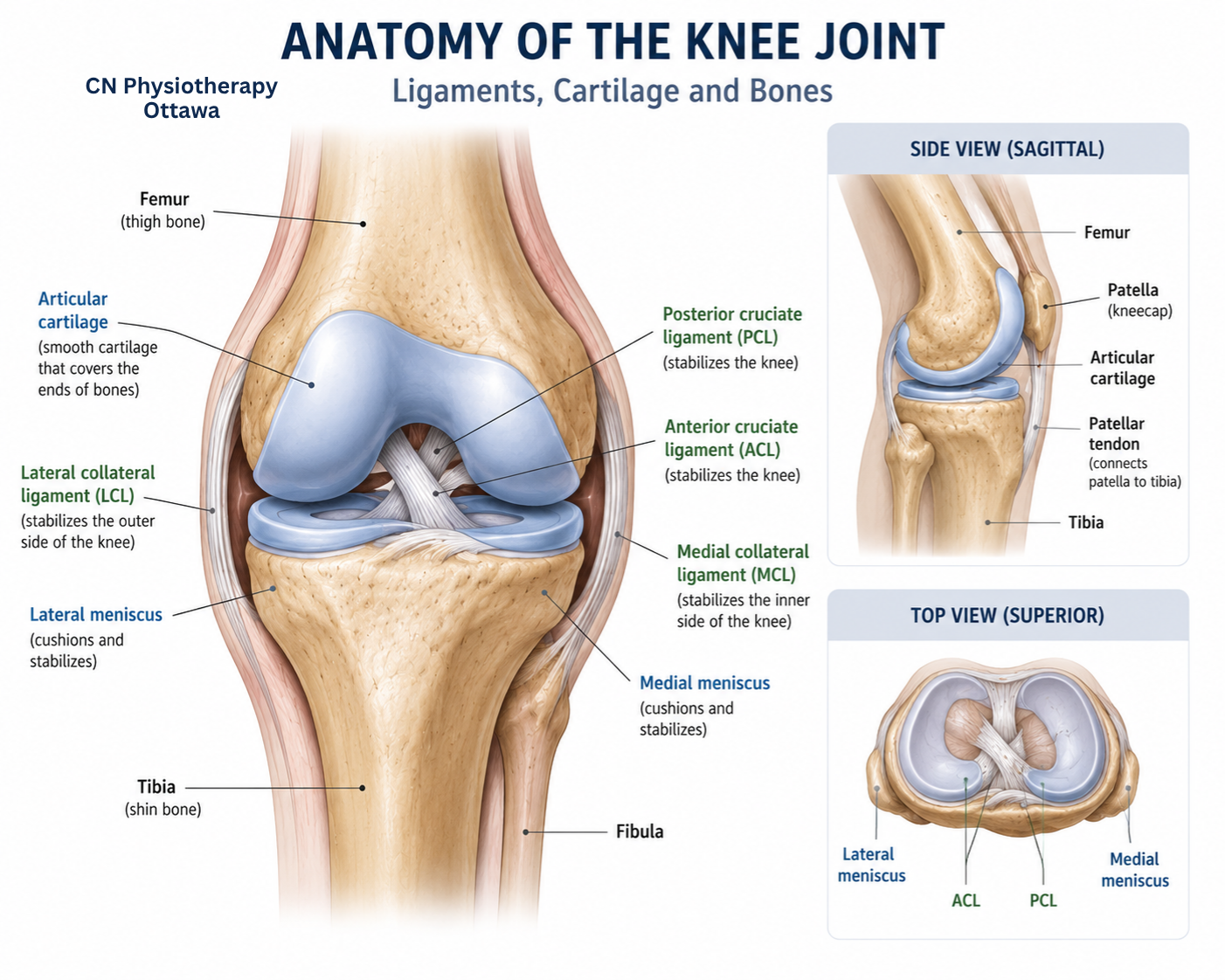
Osteoarthritis involves changes within the joint and surrounding tissues over time.
Although people sometimes describe osteoarthritis simply as “wear and tear,” that explanation can make the condition sound as though the joint is a machine gradually wearing out.
The reality is more complicated.
Your joints are living structures, and your muscles, nervous system, activity levels, strength, mobility, general health, and many other factors can influence how you feel and function.
That is important because an osteoarthritis diagnosis does not mean you are destined to become progressively less active.
What Does Knee Arthritis Feel Like?
Knee osteoarthritis can present differently from person to person.
Common symptoms may include:
- Knee pain
- Morning stiffness
- Stiffness after sitting
- Difficulty climbing stairs
- Pain when walking
- Difficulty squatting
- Reduced knee movement
- Swelling
- Grinding or clicking sensations
- Difficulty getting out of a chair
- Reduced walking tolerance
You may notice symptoms are worse on some days than others.
Your knee may also feel stiff when you first begin moving and then become more comfortable after several minutes.
What Does Hip Arthritis Feel Like?
Hip osteoarthritis may cause pain or stiffness around the hip and surrounding areas.
Some people feel discomfort around the groin.
Others experience pain around the outside of the hip, buttock, or upper thigh.
You may notice difficulty with:
- Walking
- Getting out of a chair
- Getting into or out of a car
- Putting on socks
- Putting on shoes
- Climbing stairs
- Squatting
- Getting out of bed
- Standing after sitting
- Walking longer distances
Reduced hip mobility can also make certain everyday activities more challenging.
Why Does Arthritis Hurt More After Sitting?
People with knee or hip osteoarthritis commonly report stiffness after being still.
You may feel relatively comfortable while sitting, but the first several steps after standing can be difficult.
After moving around, symptoms may improve.
This is one reason appropriate movement can be useful for people with arthritis.
Avoiding movement entirely may contribute to additional stiffness and weakness.
Why Does My Knee Hurt Going Up or Down Stairs?
Stairs require significantly more work from your legs than level walking.
Your quadriceps, hips, calves, and other muscles must generate and control force while your knee moves under load.
If your knee is painful or your leg has become weaker, stairs may become particularly challenging.
Some people notice more discomfort going downstairs because the muscles must control the lowering movement.
Physiotherapy can assess both the painful joint and the strength needed to perform the task.
Why Does My Hip Hurt When Walking?
Walking requires repeated movement through the hip while the joint supports your body.
Hip arthritis may reduce mobility and make walking uncomfortable.
Weakness in surrounding muscles may also affect how efficiently you move.
Your physiotherapist can assess:
- Hip mobility
- Leg strength
- Balance
- Walking pattern
- Functional movement
- Activity tolerance
Treatment can then focus on the areas most relevant to your symptoms.
Should I Exercise If I Have Arthritis?
This is one of the most important questions people with osteoarthritis ask.
In many cases, yes.
Appropriately prescribed exercise can be an important component of osteoarthritis management.
The challenge is finding the appropriate amount.
If you haven’t exercised for months and suddenly attempt a very demanding workout, your joints may become irritated.
But avoiding exercise altogether can contribute to:
- Muscle weakness
- Reduced endurance
- Reduced mobility
- Poorer balance
- Reduced confidence
- Lower activity levels
A physiotherapist can help you begin at an appropriate level and progressively increase activity.
Doesn’t Exercise Wear Out My Joints Faster?
This is a common concern.
People may be afraid to exercise after being told their joint has arthritis because they imagine every step causing additional damage.
That fear can lead to less movement.
Then the muscles supporting the joint become weaker.
Walking becomes harder.
Stairs become harder.
And physical activity decreases even further.
Exercise should be appropriately selected and progressed, but an osteoarthritis diagnosis does not automatically mean you should avoid using the joint.
The goal is to help your body become more capable of handling everyday activity.
How Can Physiotherapy Help Arthritis?
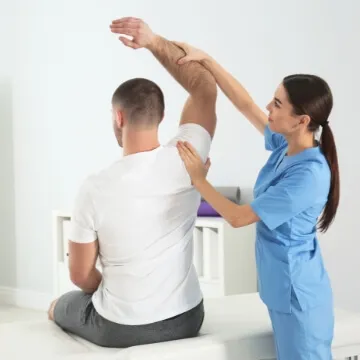
Physiotherapy can help address many of the functional problems associated with knee and hip arthritis.
Your treatment may focus on:
- Strength
- Mobility
- Balance
- Walking
- Endurance
- Joint movement
- Activity tolerance
- Pain management
- Confidence with movement
Your physiotherapist can also help you understand which activities are appropriate and how to progress them.
Strengthening for Knee Arthritis
Strengthening the muscles surrounding the knee can be an important part of treatment.
Your rehabilitation may include exercises for your:
- Quadriceps
- Hamstrings
- Calves
- Hips
- Gluteal muscles
Stronger muscles can help you perform everyday movements more effectively.
The goal isn’t necessarily to become a competitive weightlifter.
It may simply be to make it easier to:
- Stand from a chair
- Climb stairs
- Walk through the grocery store
- Get down to the floor
- Play with grandchildren
- Walk around your neighbourhood
Those are meaningful rehabilitation goals.
Strengthening for Hip Arthritis
Hip strengthening may focus on the muscles surrounding the hip and pelvis.
Depending on your assessment, exercises may target:
- Gluteal muscles
- Hip abductors
- Hip extensors
- Quadriceps
- Core muscles
Exercises can gradually progress as your ability improves.
Therapeutic Exercise for Arthritis
At CN Physiotherapy, therapeutic exercise can be incorporated into treatment to help improve strength, mobility, balance, and physical function.
Your exercise plan should reflect your individual abilities.
Someone who currently struggles to walk around the block should not receive the same starting program as someone who regularly plays golf and cycles.
Your physiotherapist can adapt exercises to your current level.
What Is the GLA:D™ Program?
CN Physiotherapy is proud to offer the GLA:D™ Program for people living with symptoms of knee and hip osteoarthritis.
GLA:D™ stands for Good Life with osteoArthritis: Denmark.
The program originated in Denmark and combines patient education with targeted neuromuscular exercise.
It is designed specifically for people with symptoms of hip and/or knee osteoarthritis.
Rather than simply telling patients to “exercise more,” GLA:D™ provides a structured program.
What Happens During the GLA:D™ Program?
At CN Physiotherapy, patients begin with an assessment by a physiotherapist certified to administer the GLA:D™ Canada program.
The program includes:
- Two 90-minute education sessions
- Twelve 60-minute group exercise classes
- Exercise sessions held twice per week
- Monitoring of function, discomfort, and quality of life
Your physiotherapist guides you through the program and helps ensure exercises are appropriate for your abilities.
This combination of education and exercise is important.
Understanding arthritis can reduce uncertainty while structured exercise gives you practical tools for improving function.
What Results Have Been Reported With GLA:D™?
According to previously reported GLA:D™ Canada program outcomes, participants have demonstrated improvements in areas such as pain, physical activity, walking ability, and medication use.
The program has reported that many participants find the education and exercise approach beneficial.
Individual results vary, and no treatment can guarantee a particular outcome.
However, GLA:D™ provides a structured, evidence-based approach for people who want to actively manage knee or hip osteoarthritis.
Do I Need Severe Arthritis to Join GLA:D™?
You do not necessarily need to wait until arthritis has severely affected your mobility before asking about treatment.
If knee or hip osteoarthritis is interfering with your activity, speak with a physiotherapist about whether the GLA:D™ Program may be appropriate.
Earlier intervention may help you learn strategies for maintaining strength and activity.
What Is Neuromuscular Exercise?
Neuromuscular exercise focuses on more than simply making a muscle stronger.
It can involve:
- Strength
- Balance
- Coordination
- Movement control
- Functional activities
For someone with knee or hip osteoarthritis, these exercises may help improve the way everyday movements are performed.
Can Walking Help Arthritis?
Walking can be an excellent form of physical activity for many people with arthritis.
However, the amount matters.
Suppose you currently tolerate a 15-minute walk comfortably.
Attempting a two-hour walk may be too large an increase.
Instead, you can gradually build your walking tolerance.
Your physiotherapist can help establish an appropriate starting point.
What If Walking Makes My Knee Hurt?
Pain does not always mean you must completely stop.
Your symptoms need to be interpreted in context.
A physiotherapist may look at:
- How much pain you experience
- When the pain occurs
- How long it lasts
- Whether swelling develops
- Whether symptoms return to baseline
- How much activity you performed
From there, your activity can be adjusted.
You may temporarily reduce walking distance and progressively increase it again.
Can Cycling Be Good for Knee or Hip Arthritis?
Cycling may be an appropriate cardiovascular activity for many people with knee or hip osteoarthritis.
It allows repeated joint movement while providing adjustable resistance.
Stationary cycling can also be useful during Ottawa winters when outdoor walking conditions are less predictable.
Whether cycling is appropriate for you depends on your individual condition.
What About Swimming?
Swimming and aquatic exercise can be another option for staying active.
Water reduces the amount of body weight supported by the joints while still allowing movement and exercise.
This can make aquatic exercise appealing for people who find land-based exercise initially difficult.
Is It Normal for My Knee to Make Noise?
Knees can click, crack, or make other noises for many reasons.
Noise by itself does not necessarily mean something dangerous is happening.
If clicking or grinding occurs with significant pain, swelling, locking, instability, or functional problems, an assessment may be appropriate.
Do I Need an X-Ray Before Physiotherapy?
Not always.
Your symptoms and physical function can often be assessed without imaging.
In certain circumstances, your healthcare provider may recommend an X-ray or other investigation.
If you already have imaging results, bring them to your appointment.
However, treatment should consider the person rather than focusing exclusively on what an image looks like.
My X-Ray Says My Arthritis Is Severe. Does That Mean My Pain Will Be Severe?
Not necessarily.
Imaging findings and symptoms do not always match perfectly.
Two people may have similar findings on an X-ray yet experience very different levels of pain and function.
Your treatment should therefore consider:
- Symptoms
- Strength
- Mobility
- Function
- Activity
- Goals
—not imaging alone.
Do I Need Surgery for Knee or Hip Arthritis?
Some people with advanced osteoarthritis eventually undergo joint replacement surgery.
However, not everyone with arthritis requires surgery.
Conservative management options such as physiotherapy, exercise, education, and activity modification may be appropriate depending on the individual.
If surgery becomes necessary, physiotherapy may also play a role before and after the procedure.
Can Physiotherapy Help Me Delay Surgery?
Physiotherapy cannot guarantee that surgery will never be required.
However, improving strength, mobility, and function may help some people manage symptoms and remain active.
Your healthcare team can help determine which treatment options are appropriate based on your individual situation.
Can Manual Therapy Help Arthritis?
Manual therapy may be incorporated into an arthritis treatment program when appropriate.
Hands-on techniques may help address joint stiffness or mobility restrictions.
However, passive treatment alone does not build strength.
For that reason, manual therapy is often combined with active exercise.
Can TENS Help Arthritis Pain?
CN Physiotherapy also offers Transcutaneous Electrical Nerve Stimulation (TENS).
TENS uses electrical stimulation and may be incorporated into physiotherapy for pain management in appropriate patients.
It should be viewed as one possible component of treatment rather than a replacement for exercise and movement.
Can IFC Help Arthritis Pain?
Interferential Current Therapy (IFC) is another modality available at CN Physiotherapy.
IFC uses electrical stimulation and may be used as part of a physiotherapy program for certain painful conditions, including arthritis-related symptoms.
Your physiotherapist can determine whether IFC is appropriate for you.
Does Losing Weight Help Knee Arthritis?
Body weight can influence the forces experienced by weight-bearing joints such as the knees and hips.
For some individuals, weight management may be one component of an overall arthritis management strategy.
However, arthritis treatment should not be reduced to weight alone.
Strength, physical activity, mobility, general health, and individual circumstances all matter.
Arthritis and Ottawa Winters
Ottawa winters can make staying active challenging.
Snow, ice, cold temperatures, and shorter days may reduce outdoor activity.
For someone with arthritis, several months of reduced activity may contribute to weakness and reduced conditioning.
Consider finding ways to continue moving throughout winter.
Depending on your abilities, this might include:
- Indoor walking
- Stationary cycling
- Home exercises
- Strength training
- Aquatic exercise
- Physiotherapy exercises
Consistency is often more useful than trying to suddenly regain all your fitness when spring arrives.
Arthritis and Fall Prevention
Knee or hip pain can sometimes affect balance and confidence.
If pain has caused you to become less active, leg strength may also decrease.
For older adults, maintaining strength and balance becomes particularly important.
CN Physiotherapy also offers Fall Prevention programs for people concerned about balance or falling.
Your physiotherapist can determine whether balance training should be incorporated into your treatment.
Arthritis Treatment for Cumberland and Ottawa Residents
For people living in Cumberland and Ottawa, arthritis can interfere with many of the activities that make life enjoyable.
Maybe you want to walk around your neighbourhood.
Perhaps you want to garden.
Maybe you enjoy golf.
You may want to stay active with your grandchildren.
Or perhaps your goal is simply getting up and down the stairs without worrying about your knee.
These goals matter.
Physiotherapy should not focus exclusively on a diagnosis.
It should focus on what that diagnosis is preventing you from doing.
How Much Exercise Should I Do?
There is no universal amount that is appropriate for every person with arthritis.
Your starting point depends on your:
- Current activity level
- Symptoms
- Strength
- Mobility
- Medical history
- Goals
A physiotherapist can help establish an exercise level that challenges you without unnecessarily overwhelming your joints.
From there, activity can gradually progress.
What If My Arthritis Flares Up?
Arthritis symptoms can fluctuate.
Having a painful day does not necessarily mean all your progress has disappeared.
During a flare, your activity may temporarily need modification.
Your physiotherapist can teach you strategies for adjusting exercise while maintaining as much movement as is appropriate.
Knowing what to do during a flare can help prevent the cycle of stopping all activity every time symptoms increase.
When Should I See a Physiotherapist for Arthritis?
Consider scheduling an assessment if:
- Knee or hip pain is limiting your walking
- Stairs have become difficult
- You feel weaker
- Your joints are becoming stiff
- You have stopped exercising because of pain
- You are worried about losing mobility
- You have difficulty standing from a chair
- Arthritis is affecting work or recreation
- You want a structured exercise program
- You are interested in the GLA:D™ Program
- You want to remain active despite osteoarthritis
You do not have to wait until your mobility becomes severely limited.
Frequently Asked Questions About Knee and Hip Arthritis
Can physiotherapy help knee arthritis?
Physiotherapy can help people with knee osteoarthritis improve strength, mobility, balance, walking ability, and overall function. Treatment should be individualized.
Can physiotherapy help hip arthritis?
Yes. Physiotherapy may help improve hip and lower-limb strength, mobility, walking tolerance, and functional movement.
Is walking bad for arthritic knees?
Walking is not automatically bad for arthritic knees. The appropriate amount depends on your current tolerance and symptoms.
Should I rest when arthritis hurts?
Short periods of activity modification may sometimes be useful, but prolonged inactivity can contribute to weakness and stiffness. Your physiotherapist can help determine an appropriate balance.
Is arthritis reversible?
Osteoarthritis involves structural changes within the joint that are not simply “reversed” through exercise. However, symptoms and physical function can often change, which is why treatment can still be worthwhile.
What exercises are best for knee arthritis?
There is no single best exercise. Strengthening the legs and hips, improving mobility, and performing appropriate cardiovascular activity may all be helpful depending on the individual.
What exercises are best for hip arthritis?
Hip and leg strengthening, mobility exercises, balance work, and cardiovascular activity may be included depending on your symptoms and assessment.
What is the GLA:D™ Program?
GLA:D™ is an evidence-based education and neuromuscular exercise program developed specifically for people with symptoms of knee and hip osteoarthritis.
Does CN Physiotherapy offer GLA:D™?
Yes. CN Physiotherapy offers the GLA:D™ Canada program for appropriate patients with hip and/or knee osteoarthritis.
Will exercise make arthritis worse?
Appropriately prescribed exercise is commonly used as part of osteoarthritis management. Exercise intensity and progression should reflect your individual tolerance.
Can arthritis cause morning stiffness?
Yes. People with osteoarthritis commonly experience stiffness after sleeping or sitting for prolonged periods.
Why does my knee hurt after sitting?
Knee arthritis can cause stiffness following periods of inactivity. Some people notice the first few steps are uncomfortable before movement becomes easier.
Can arthritis affect balance?
Pain, weakness, reduced mobility, and lower activity levels may contribute to balance difficulties in some people.
Do I have to stop playing golf if I have arthritis?
Not necessarily. Depending on your symptoms, physiotherapy may help you modify activity and improve the physical abilities required for golf.
Is cycling good for arthritis?
Cycling can be an appropriate low-impact cardiovascular exercise for many people with knee or hip osteoarthritis, although individual suitability varies.
Can I still strength train with arthritis?
Many people with osteoarthritis can participate in appropriately modified strength training. A physiotherapist can help determine a suitable starting level.
How CN Physiotherapy Can Help
An arthritis diagnosis does not mean you have to give up the activities you enjoy.
At CN Physiotherapy, we can assess how knee or hip pain is affecting your movement and create an individualized treatment plan designed around your goals.
Depending on your needs, treatment may include:
- Physiotherapy
- GLA:D™ Program
- Therapeutic exercise
- Strengthening
- Mobility exercises
- Balance training
- Manual therapy
- TENS
- Interferential Current Therapy (IFC)
- Fall prevention
- Walking and activity progression
- Education about osteoarthritis
Our goal is to help you maintain or improve your ability to move, exercise, work, and participate in everyday life.
We proudly help patients from Cumberland, Ottawa, Orléans, Fallingbrook, Navan, Blackburn Hamlet, Beacon Hill, Nepean, and surrounding communities.
Keep Moving With Knee or Hip Arthritis
When a joint hurts, avoiding movement can feel like the safest option.
But gradually becoming less active can lead to weaker muscles, lower endurance, reduced confidence, and even more difficulty performing everyday activities.
A better approach is often learning how to move at an appropriate level and progressively build your capacity.
Physiotherapy can help you understand your symptoms, strengthen the muscles surrounding your joints, improve mobility, and develop a realistic plan for staying active.
And for appropriate patients with knee or hip osteoarthritis, the GLA:D™ Program at CN Physiotherapy provides a structured combination of education and exercise.
If you are experiencing knee or hip arthritis pain in Cumberland, Ottawa, Orléans, Fallingbrook, Navan, Blackburn Hamlet, Beacon Hill, Nepean, or surrounding areas, contact CN Physiotherapy to request an appointment.
Your recovery can start today.
Request an appointment with CN Physiotherapy.