Chronic tendon pain can be incredibly frustrating. Unlike a muscle strain that often improves after a few days of rest, tendon injuries can linger for months or even years. Everyday activities such as climbing stairs, reaching overhead, running, lifting groceries, or enjoying your favourite sport may become increasingly difficult as pain continues to return.
Many people living with chronic tendon pain try rest, ice, stretching, pain medication, or activity modification with only temporary relief. While these approaches may reduce symptoms for a short time, they do not always address the underlying changes occurring within the injured tendon.
One treatment that has gained significant attention in physiotherapy is Shockwave Therapy. This non-invasive treatment is commonly used to help manage chronic tendon conditions by encouraging the body’s natural healing response while reducing pain and improving function.
At CN Physiotherapy, we provide Shockwave Therapy as part of comprehensive rehabilitation programs for patients throughout Ottawa, Orléans, Fallingbrook, Navan, Blackburn Hamlet, Beacon Hill, Cumberland, and Nepean.
Understanding Tendon Pain
Tendons are strong bands of connective tissue that attach muscles to bones. Every time you move, your tendons transfer force from your muscles to your joints, allowing you to walk, lift, jump, throw, and perform countless daily activities.
Because tendons are constantly under stress, they can become irritated when the amount of force placed on them exceeds their ability to recover.
Unlike muscles, tendons receive a relatively limited blood supply. This means they often heal more slowly, particularly when the problem has been present for several months.
Acute vs. Chronic Tendon Pain
Not every tendon injury is the same.
An acute tendon injury often develops suddenly after an accident, sporting incident, or unexpected overload.
Chronic tendon pain develops gradually over time.
Instead of one major injury, the tendon experiences repeated stress without enough time to recover. Eventually, pain becomes persistent and may begin interfering with normal activities.
Many patients continue exercising through mild discomfort until everyday tasks also become painful.
Common Causes of Chronic Tendon Pain
Several factors may contribute to tendon injuries.
These include:
- Repetitive movements
- Sudden increases in exercise
- Poor movement mechanics
- Muscle weakness
- Reduced flexibility
- Age-related tendon changes
- Poor recovery between activities
- Returning to sport too quickly
- Occupational demands
- Previous tendon injuries
It is often a combination of these factors rather than one single event that causes chronic tendon pain.
Common Tendon Conditions Treated With Shockwave Therapy
Shockwave Therapy is commonly used for several musculoskeletal tendon conditions.
These include:
Plantar Fasciitis
Pain underneath the heel is one of the most common reasons people seek Shockwave Therapy.
Many patients notice severe pain during their first few steps in the morning or after sitting for long periods.
Achilles Tendinopathy
Pain at the back of the ankle may develop after running, walking, hiking, or prolonged standing.
Symptoms often worsen during activity and improve temporarily with rest before returning again.
Tennis Elbow
Despite its name, tennis elbow affects many people who have never played tennis.
It commonly develops from repetitive gripping, lifting, typing, construction work, or gardening.
Pain is usually felt along the outside of the elbow and may make lifting everyday objects uncomfortable.
Golfer’s Elbow
Golfer’s elbow causes pain on the inside of the elbow and may develop through repetitive gripping or wrist movements.
Rotator Cuff Tendinopathy
The shoulder contains several tendons that help stabilize and move the arm.
These tendons may become irritated through repetitive overhead activities, sports, workplace demands, or age-related changes.
Patellar Tendinopathy
Often called jumper’s knee, this condition affects the tendon below the kneecap.
It commonly develops in runners, basketball players, volleyball players, and individuals who frequently jump or squat.
What Is Shockwave Therapy?
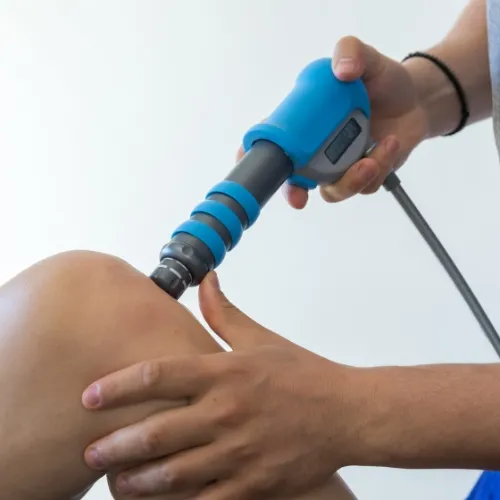
Shockwave Therapy uses high-energy acoustic waves that are delivered directly to the injured tissue.
Despite the name, there is no electrical shock involved.
Instead, controlled sound waves are transmitted through the skin into the affected tendon.
The treatment is completely non-invasive, meaning there are no injections or surgical incisions.
Sessions are typically short and are often combined with an active physiotherapy rehabilitation program.
How Shockwave Therapy Works
Although researchers continue studying the exact mechanisms, Shockwave Therapy is believed to stimulate several important biological responses within damaged tissue.
These include:
Increased Blood Flow
Healthy circulation is essential for healing.
Shockwave Therapy may encourage the development of new blood vessels within injured tissue, improving the delivery of oxygen and nutrients required for recovery.
Collagen Production
Collagen is one of the primary building blocks of healthy tendons.
Shockwave Therapy may stimulate collagen production, supporting the repair and strengthening of injured tissue.
Pain Reduction
Many patients notice gradual improvements in pain following treatment.
Shockwave Therapy is believed to influence pain signalling while also encouraging tissue healing.
Breakdown of Calcifications
Some chronic tendon conditions involve small calcium deposits within the tendon.
Shockwave Therapy may help break down these deposits, improving movement and reducing discomfort.
Improved Tissue Healing
Rather than simply masking symptoms, Shockwave Therapy aims to stimulate the body’s own healing processes.
This is one reason why improvements often continue developing over several weeks following treatment.
What Does Treatment Feel Like?
Many patients are understandably curious about what Shockwave Therapy feels like.
During treatment, a physiotherapist applies a special gel to the treatment area before placing the Shockwave applicator against the skin.
As the acoustic waves are delivered, you may notice a tapping sensation.
Some areas may feel more sensitive than others, particularly around chronic tendon injuries.
Your physiotherapist can adjust the intensity throughout the session to ensure the treatment remains appropriate for your comfort and condition.
Most appointments last only a few minutes for the Shockwave portion of treatment.
What Happens After Treatment?
It is common to experience mild soreness following Shockwave Therapy.
This temporary discomfort usually settles within a day or two.
Many patients are able to continue normal daily activities following treatment, although your physiotherapist may recommend temporarily modifying certain high-impact activities depending on your condition.
Recovery does not happen instantly.
Shockwave Therapy works by encouraging healing, meaning improvements often occur gradually over several weeks.
Why Shockwave Therapy Works Best With Physiotherapy
Shockwave Therapy should not be viewed as a stand-alone solution.
Tendon pain usually develops because the tendon has been overloaded, not simply because the tendon is painful.
If weakness, poor movement mechanics, limited mobility, or training errors are not addressed, symptoms may eventually return.
For this reason, Shockwave Therapy is often combined with:
- Therapeutic exercise
- Progressive strengthening
- Manual therapy
- Mobility exercises
- Activity modification
- Movement retraining
- Education regarding load management
This combined approach addresses both the painful tendon and the factors contributing to the injury.
Is Shockwave Therapy Right for Everyone?
Although Shockwave Therapy has helped many people with chronic tendon conditions, it is not appropriate for every patient.
Your physiotherapist will complete a thorough assessment before determining whether Shockwave Therapy is suitable for your diagnosis.
Treatment recommendations depend on:
- Your symptoms
- Medical history
- Activity level
- Duration of pain
- Previous treatment
- Overall health
- Type of tendon injury
An individualized assessment helps ensure the treatment plan matches your specific needs.
Benefits of Shockwave Therapy
Many patients choose Shockwave Therapy because it offers several potential advantages.
These include:
- Non-invasive treatment
- No surgical incisions
- No anesthesia required
- No medication required during treatment
- Short treatment sessions
- Supports the body’s natural healing response
- May reduce chronic pain
- May improve mobility
- Can be combined with physiotherapy exercises
Every patient’s response is different, and results depend on the condition being treated, the duration of symptoms, and participation in the rehabilitation program.
How Physiotherapy Helps Maximize Recovery
Shockwave Therapy is only one part of successful rehabilitation.
Your physiotherapist may also evaluate:
- Muscle strength
- Joint mobility
- Balance
- Walking pattern
- Running mechanics
- Sport technique
- Work demands
- Flexibility
- Activity progression
By addressing these factors alongside Shockwave Therapy, the goal is not only to reduce pain but also to improve long-term function and reduce the likelihood of recurrence.
How CN Physiotherapy Can Help
At CN Physiotherapy, every patient begins with a comprehensive assessment to determine the true cause of their tendon pain.
If Shockwave Therapy is appropriate, it becomes part of a personalized rehabilitation program designed specifically for your condition and recovery goals.
Our experienced physiotherapists work closely with patients to reduce pain, improve movement, restore strength, and safely return them to work, sports, and everyday activities.
We proudly serve patients throughout Ottawa, Orléans, Fallingbrook, Navan, Blackburn Hamlet, Beacon Hill, Cumberland, Nepean, and surrounding communities.
Frequently Asked Questions
Is Shockwave Therapy painful?
Some patients experience mild discomfort during treatment, particularly over sensitive tendon areas. The intensity can be adjusted by your physiotherapist to keep treatment tolerable.
How many Shockwave Therapy sessions will I need?
The number of sessions depends on your diagnosis, symptom severity, and how your body responds to treatment. Your physiotherapist will recommend a treatment plan based on your assessment.
Can Shockwave Therapy help chronic tendon pain?
Shockwave Therapy is commonly used for chronic tendon conditions such as plantar fasciitis, Achilles tendinopathy, tennis elbow, and rotator cuff tendinopathy as part of a comprehensive rehabilitation program.
Will I need to stop exercising?
Not necessarily. Your physiotherapist may modify your activity rather than stopping it completely. Gradual loading is often an important part of tendon rehabilitation.
How quickly will I notice improvement?
Some patients notice improvement after only a few treatments, while others experience gradual progress over several weeks as tissue healing continues.
Is Shockwave Therapy better than surgery?
Shockwave Therapy is a non-invasive treatment option that may be appropriate for certain chronic tendon conditions. Whether surgery is necessary depends on your diagnosis and should be determined following a comprehensive assessment.
Can Shockwave Therapy be combined with other physiotherapy treatments?
Yes. Shockwave Therapy is often combined with strengthening exercises, manual therapy, mobility work, and education to provide a comprehensive treatment approach.
Who should avoid Shockwave Therapy?
Certain medical conditions or circumstances may make Shockwave Therapy unsuitable. Your physiotherapist will review your medical history and determine whether it is an appropriate treatment for you.
Take the First Step Toward Long-Term Tendon Pain Relief
Chronic tendon pain can limit your ability to work, exercise, participate in sports, and enjoy everyday activities. While rest alone often provides only temporary relief, a personalized rehabilitation program may help address both the symptoms and the underlying cause of your condition.
If you’ve been living with persistent tendon pain, contact CN Physiotherapy today to schedule a comprehensive assessment. Our experienced team will determine whether Shockwave Therapy and physiotherapy are appropriate for your recovery and help you return to the activities you enjoy with greater confidence and comfort.