Running is one of the most accessible ways to stay active. Whether you’re training for your first 5K, preparing for the Ottawa Race Weekend, enjoying the trails in Gatineau Park, or simply jogging through your neighbourhood in Orléans or Blackburn Hamlet, running offers tremendous physical and mental health benefits.
However, running also places repetitive stress on your muscles, tendons, joints, and bones. Every step generates forces that travel through your feet, ankles, knees, hips, and spine. When your body is not prepared for those demands—or when training increases too quickly—injuries can develop.
The good news is that most running injuries are treatable, and many are preventable with proper assessment, rehabilitation, and training guidance.
At CN Physiotherapy, we regularly help runners throughout Ottawa, Orléans, Fallingbrook, Navan, Beacon Hill, Cumberland, Nepean, and surrounding communities recover from injuries and return to running safely.
Why Do Running Injuries Happen?
Many runners assume an injury appears because they “ran too much.”
While training volume certainly plays a role, injuries usually develop because several factors combine together.
Common contributing factors include:
- Increasing mileage too quickly
- Running too many hills
- Poor recovery between runs
- Muscle weakness
- Reduced flexibility
- Previous injuries
- Poor running mechanics
- Wearing worn-out footwear
- Returning to running too soon after time off
- Lack of strength training
Most running injuries develop gradually rather than from one specific event.
Ignoring early warning signs often allows a small problem to become a larger one.
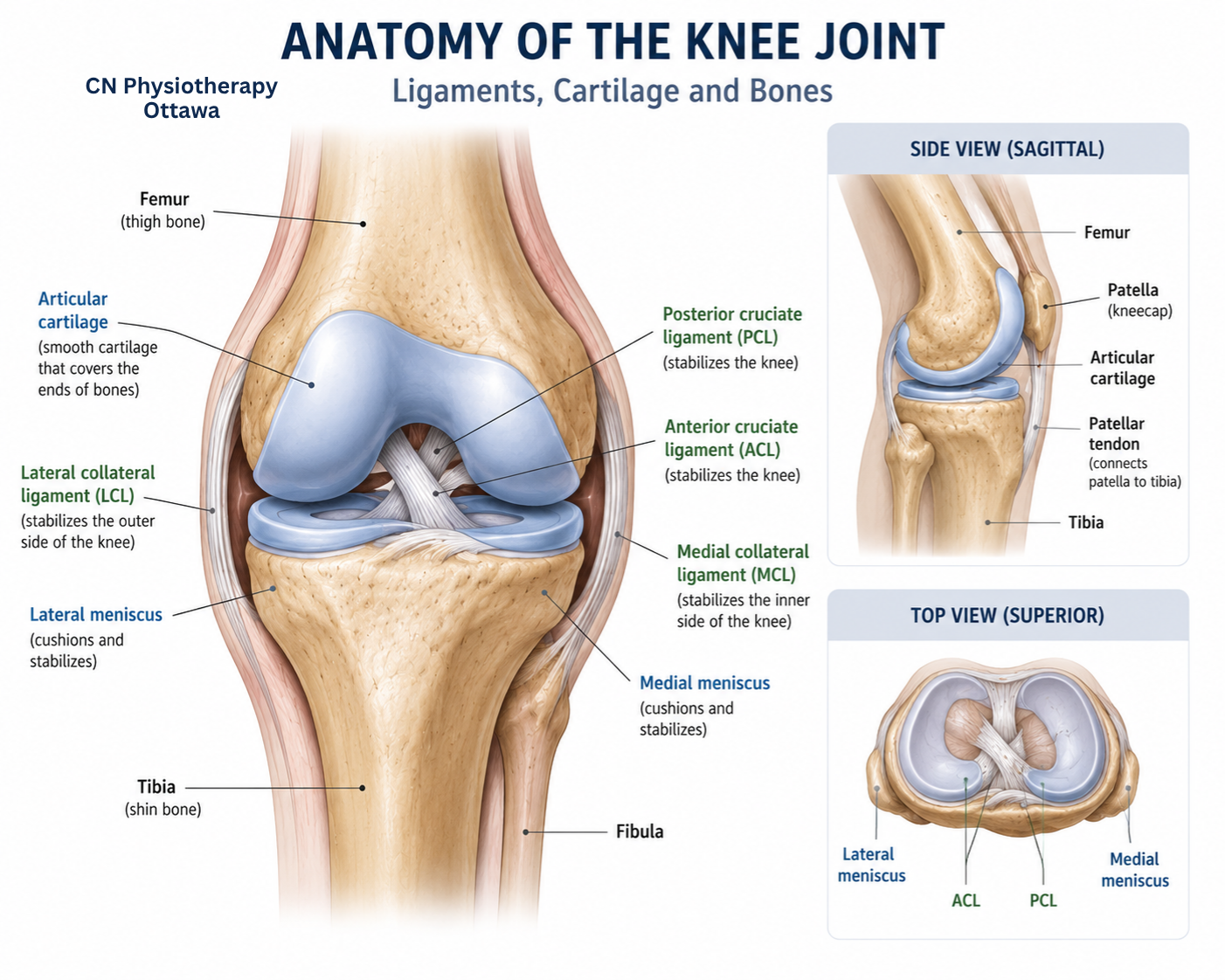
1. Runner’s Knee (Patellofemoral Pain Syndrome)
Runner’s knee is one of the most common conditions we treat.
Pain develops around or behind the kneecap and often becomes worse during activities that increase pressure through the joint.
Symptoms may include:
- Pain at the front of the knee
- Pain when running downhill
- Pain climbing stairs
- Pain after prolonged sitting
- Clicking around the kneecap
- Stiffness after running
Runner’s knee may develop when the kneecap does not move efficiently during activity or when weakness in the hips and thighs changes movement mechanics.
Treatment often includes:
- Hip strengthening
- Quadriceps strengthening
- Running assessment
- Movement retraining
- Flexibility exercises
- Gradual return-to-running programs
2. Achilles Tendinopathy
The Achilles tendon connects the calf muscles to the heel bone and absorbs tremendous forces while running.
When overloaded, it may become painful and stiff.
Common symptoms include:
- Pain above the heel
- Morning stiffness
- Pain at the beginning of a run
- Tenderness when squeezing the tendon
- Thickening of the tendon
- Difficulty pushing off while running
Ignoring Achilles pain often makes recovery longer.
Physiotherapy commonly focuses on:
- Progressive calf strengthening
- Load management
- Mobility exercises
- Running modification
- Manual therapy when appropriate
- Gradual return to training
3. Plantar Fasciitis
Plantar fasciitis affects the thick band of tissue along the bottom of the foot.
Many runners describe sharp heel pain during their first steps in the morning.
Symptoms often include:
- Heel pain
- Pain after getting out of bed
- Pain after sitting
- Pain after long runs
- Tenderness beneath the heel
Treatment may include:
- Foot strengthening
- Calf stretching
- Manual therapy
- Taping
- Orthotic assessment when appropriate
- Running modifications
4. IT Band Syndrome
The iliotibial (IT) band runs from the hip to the outside of the knee.
IT band syndrome commonly develops in runners who increase mileage, train on hills, or repeatedly run on sloped surfaces.
Symptoms include:
- Pain on the outside of the knee
- Pain beginning after several kilometres
- Sharp discomfort downhill
- Tenderness along the outer knee
- Pain that settles after stopping
Physiotherapy treatment often focuses on:
- Hip strengthening
- Glute strengthening
- Running mechanics
- Training modifications
- Mobility exercises
5. Shin Splints
Shin splints (medial tibial stress syndrome) cause pain along the inside of the shinbone.
The condition frequently develops after sudden increases in:
- Running distance
- Speed work
- Hill training
- Training frequency
Symptoms include:
- Pain along the shin
- Tenderness during activity
- Soreness after running
- Tight calves
If ignored, shin splints may progress to stress injuries.
Treatment typically includes:
- Load management
- Progressive strengthening
- Foot and ankle exercises
- Running progression
- Flexibility training
6. Hamstring Strains
Although hamstring strains are common in sprinting sports, distance runners can also experience them.
Symptoms may include:
- Pain in the back of the thigh
- Tightness while running
- Pain accelerating
- Difficulty climbing hills
- Weakness
Rehabilitation focuses on:
- Progressive strengthening
- Flexibility
- Running drills
- Speed progression
- Return-to-running programs
7. Hip Tendinopathy
Pain on the outside of the hip may develop when the gluteal tendons become overloaded.
This condition is particularly common among runners who increase training too quickly.
Symptoms include:
- Pain on the side of the hip
- Pain while lying on one side
- Pain climbing stairs
- Pain after longer runs
Treatment often includes:
- Hip strengthening
- Load management
- Running modifications
- Balance training
8. Stress Fractures
Stress fractures occur when repetitive loading exceeds the bone’s ability to recover.
Common locations include:
- Tibia
- Foot
- Metatarsals
- Femur
Symptoms may include:
- Localized pain
- Pain that becomes progressively worse
- Pain even during walking
- Tenderness over one small area
- Swelling
Stress fractures require medical assessment and should never be ignored.
Continuing to run through this type of pain may lead to a complete fracture.
9. Ankle Sprains
Trail runners and runners training during Ottawa winters occasionally experience ankle sprains.
Even after swelling improves, balance deficits may remain.
Rehabilitation commonly includes:
- Balance exercises
- Strengthening
- Mobility restoration
- Running progression
- Sport-specific drills
Proper rehabilitation reduces the likelihood of future ankle injuries.
10. Low Back Pain
Not all running injuries occur in the legs.
Weakness, poor running mechanics, reduced hip mobility, or inadequate core endurance may contribute to lower back pain.
Symptoms often include:
- Tightness after running
- Pain during longer runs
- Stiffness afterward
- Difficulty bending
Treatment may include:
- Core strengthening
- Hip strengthening
- Running assessment
- Manual therapy
- Mobility exercises
When Should You Stop Running?
Not every ache requires complete rest.
However, you should reduce activity and seek assessment if:
- Pain changes your running form.
- Pain worsens during every run.
- Swelling develops.
- Pain continues after several days.
- Walking becomes painful.
- Symptoms keep returning.
Running through significant pain often prolongs recovery.
How Physiotherapy Helps Runners
Every runner is different.
Your physiotherapist will assess much more than the painful area.
Your evaluation may include:
- Running history
- Weekly mileage
- Training schedule
- Previous injuries
- Strength
- Flexibility
- Joint mobility
- Balance
- Walking mechanics
- Running mechanics
- Foot posture
- Functional movement
The goal is not simply reducing pain.
We want to identify why the injury developed and help reduce the risk of it happening again.
Running Gait Analysis
Many runners benefit from a professional running assessment.
Video gait analysis may identify:
- Overstriding
- Cadence issues
- Hip weakness
- Knee control
- Foot strike patterns
- Arm swing
- Pelvic movement
Small adjustments can sometimes reduce stress on injured tissues.
Running form changes should always be individualized rather than based on generic internet advice.
The Importance of Strength Training
Research consistently shows that runners benefit from strength training.
Common areas include:
- Glutes
- Core
- Calves
- Hamstrings
- Quadriceps
- Foot muscles
Stronger muscles absorb force more efficiently and improve running economy.
Most runners only need two strength sessions each week to see meaningful improvements.
How to Reduce Your Risk of Running Injuries
Although no injury is completely preventable, several habits may reduce your risk.
Helpful strategies include:
- Increase mileage gradually.
- Avoid sudden training spikes.
- Replace worn running shoes.
- Include strength training.
- Warm up before harder runs.
- Recover properly between sessions.
- Sleep adequately.
- Stay hydrated.
- Listen to early warning signs.
- Address minor pain before it becomes severe.
Consistency is often more important than intensity.
Frequently Asked Questions
Should I run through pain?
Mild muscle soreness after exercise is common, but pain that changes your running form or becomes progressively worse should be assessed.
Is it normal to feel sore after increasing mileage?
Some soreness is expected when training changes, but persistent pain lasting several days may indicate an overload injury.
Do I need custom orthotics?
Not every runner requires orthotics. Some runners benefit from them, while others recover successfully through strengthening, footwear changes, and training modifications.
Can physiotherapy help me run faster?
Physiotherapy primarily focuses on reducing injury risk, improving movement efficiency, restoring strength, and helping you return safely to running. Improved performance often follows better movement quality.
Should I stretch before running?
Dynamic warm-up exercises are generally preferred before running. Longer static stretching may be more appropriate after activity if flexibility is limited.
What shoes are best for runners?
There is no single “best” running shoe for everyone. The ideal shoe depends on your running style, comfort, injury history, and individual biomechanics.
How long does it take to recover from a running injury?
Recovery depends on the type and severity of the injury, how long symptoms have been present, and whether training is appropriately modified. Early treatment often shortens recovery time.
Can I continue exercising while recovering?
In many cases, yes. Your physiotherapist can recommend alternative activities such as cycling, swimming, or strength training while your running program is modified.
Return to Running With Confidence
Running injuries can be frustrating, but they do not have to end your training goals. Most injuries respond well to early assessment, appropriate rehabilitation, and gradual progression back to activity.
At CN Physiotherapy, we help runners of all experience levels recover from injuries, improve movement efficiency, and safely return to the roads, trails, races, and recreational activities they enjoy.
Whether you’re training for your first 5K, preparing for a marathon, or simply enjoy running through Ottawa’s parks and pathways, our experienced physiotherapists can help you get back on track.
If pain is keeping you from running, contact CN Physiotherapy today to schedule a comprehensive running assessment and personalized treatment plan.